Jason Staats Podcast: Building AI for Auditors with Danny Alberson
Jason Staats interviewed Danny Alberson about Agentive, Punchcard, AI audit automation, evidence testing, auditor judgment, and why firms should try software before signing long contracts.
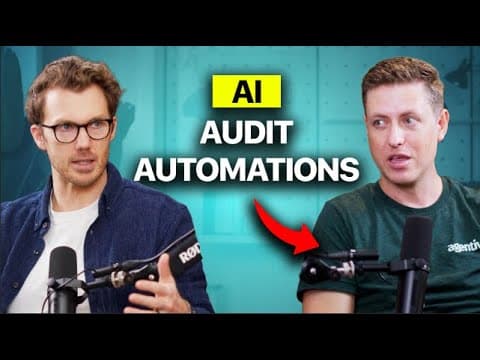
Jason Staats interviewed Danny Alberson on episode 549 of Jason On Firms Podcast about AI for auditors, evidence testing, the future of junior audit work, and why audit software needs to be built around source-backed review instead of generic chat.
The episode was published on December 5, 2025 under the title "Meet The Founder Building AI for AUDITORS." You can watch or listen below.
Listen to the episode on your preferred platform.
Key Takeaways
- Generic AI assistants are useful, but audit work needs structured workflow automation tied to requests, evidence, assertions, procedures, and review.
- Punchcard starts work when clients upload evidence, maps support to the right testing workflow, and points auditors back to citations.
- AI should reduce low-judgment execution work so auditors can spend more time on risk, exceptions, planning, and client conversations.
- Junior auditors still need to learn the work, but their role should shift toward reviewing source-backed AI work and managing agents earlier in their careers.
- Firms should be careful with long contracts for AI products they have not tried, especially when the promised capabilities are still on a roadmap.
Lightly Edited Transcript
This transcript was cleaned from a raw caption export for readability. Agentive is now Punchcard. Sponsor breaks and closing promotional segments were removed so the transcript focuses on the conversation about Agentive, Punchcard, AI audit automation, auditor judgment, and accounting software.
Opening: Why Audit Needs Better AI Tools
Jason: We have a special one today. I recently had the opportunity to chat with Danny Alberson of Agentive. He is building AI solutions for auditors, because auditors are people too, and auditors need better software.
Jason: This became a really interesting story about an accountant who became a software founder. Danny has strong views on how AI can be deployed inside audit, where legacy software providers are struggling, and how the accounting AI vertical can lean further into AI.
Jason: Danny, thanks for being here.
Danny: Pleasure. Thanks for having me, Jason.
Jason: Jumping straight in, who are Agentive's biggest fans right now? Who are the power users who love the product?
Danny: It is people like many of your viewers: people who like ChatGPT, love AI, and want to apply it to their work.
Danny: We had a customer who tried to build a custom GPT for an audit workflow. It did not really work. When we showed him Agentive, he transformed that idea into a workpaper automation in about 30 minutes. It automated 19 different steps of an audit procedure for testing whether expenses complied with government regulation.
Danny: He was blown away because we had built what he wanted a custom GPT to do, but in a way that actually worked for audit.
Jason: For people who know the ChatGPT interface, is this an AI assistant, or does it look and feel more targeted?
Danny: It is more targeted. We are purpose-built to help auditors request evidence from clients and test evidence at the same time.
Danny: In an audit, the key questions are: what accounts am I testing, what assertions am I testing, what evidence do I need, and how am I going to test it? Auditors usually already have workpapers that define those procedures. We build those workflows into the platform.
Danny: Based on the evidence being requested, Agentive knows what workflow needs to happen to complete the audit testing, or at least get the auditor most of the way there. Then we run it automatically as soon as clients upload the data, and we point back to citations in the source documents.
Jason: Every accountant has a version of the PBC list. For auditors, that can be especially ugly. How do you bridge a request list to the specific to-dos attached to each item?
Danny: First, we are not replacing the audit methodology or the audit binder. Firms still use tools like Caseware or other methodology platforms for planning. Once they decide what they are going to test, they come to Agentive.
Danny: For example, suppose you are auditing a nonprofit and need to test revenue. You can roll forward from last year or apply a nonprofit revenue template. Then we apply the audit workflow automatically when the nonprofit uploads evidence.
Danny: The client might upload support for 25 revenue transactions. If the auditor is looking for the grant contract, we match the file back to the sample selection. Clients can upload evidence directly to the relevant selection instead of dropping everything into a disorganized folder.
Danny: Then Agentive asks the questions an auditor would normally ask. Are the restrictions correct? Is it the right year? Does the evidence agree with how the transaction was recorded? We provide answers and citations within about 60 seconds of the client upload.
Jason: Is the starting point the trial balance?
Danny: Sometimes, but not always. It might be a general ledger or a subledger. Auditors take a sample using their preferred method. We can help with monetary unit sampling or haphazard sampling based on the firm's risk tolerance and confidence level.
Danny: The auditor still assesses risk independently through professional judgment and their audit methodology. Once that is done, Agentive can pull the sample, turn it into a request list, and connect it to the testing workflow.
Danny Alberson's Path From Auditor to Founder
Jason: Your background is accounting. You are not only a traditional tech founder. How did you stumble into this?
Danny: I am both. I am an accountant, and I have worked in traditional tech roles.
Danny: Growing up, I had mentors who were accountants. My scout leader was a senior manager at PwC. My bishop was the managing partner at Grant Thornton. I grew up seeing accounting as a path to stability, service, family, and a good life.
Danny: I loved technology as a kid. I built websites for fun. But I wanted to be an accountant. I studied accounting at Brigham Young University and started my career in audit at Ernst & Young.
Danny: During my first year, I realized most of my time would be spent on substantive testing and test of details. I kept asking whether the process could be improved. The answer was usually, no, just do it the way we tell you, get it done quickly, keep quality high, and later in your career you can work on planning and strategy.
Danny: I could not live with that. I wanted to fix the work.
Danny: I eventually transferred at EY into a digital transformation strategy practice. I worked with engineers and designers to build technology, including the virtual line product at Universal Studios' Volcano Bay. Later, I joined Facebook to work on augmented reality glasses.
Danny: So I care deeply about product design and engineering quality, but I also spent time as an auditor with an accounting degree. Agentive sits at the intersection of those two paths.
Jason: A lot of venture-backed founders come into accounting from the outside and look for a problem to solve. You came from the problem. What is your advice to accountants who hear your story and wonder whether they should be building technology too?
Danny: Silicon Valley would tell you there are no rules. You can do whatever you want, but the market is going to hire or fire you.
Danny: Figure out what you are good at and what you enjoy. Some people like improving processes. Some people like using very well-designed processes. You should experiment, take risks, and find where the market wants what you can uniquely offer.
Danny: There are also many roles between accountant and engineer. Audit firms have teams that manage technology, decide what to buy, and decide who to partner with. You can be a product manager, designer, engineer, technologist, or accountant. There are many ways to work between those worlds.
Where Agentive Fits Beside Core Audit Platforms
Jason: Audit software feels similar to tax software from the outside. There are huge legacy systems, and they often do not talk to anything else. A lot of AI tools require you to move work into a separate AI product, do one task, and then move it back. How do you solve that?
Danny: If we had unlimited resources, we would build everything. No one has unlimited resources. You can only do a few things really well at a time.
Danny: We prioritize the work that consumes the most billable hours and causes the most pain. Why are auditors quitting? Why are clients unhappy? How do we make the audit experience more enjoyable?
Danny: In the first years of an auditor's career, a huge share of time is spent on test of details. That often means looking at transactions, checking support, and deciding whether documents agree with how items were recorded in the general ledger. It is necessary, but it is also the work many people like least.
Danny: That is why we focus there. It is an unsolved problem. Old tools could do OCR or exact text matching. They could find a phrase in a document. But now you can ask, what are the restrictions in this grant contract, and get a source-backed answer at scale across 50 selections.
Danny: You can do the work once and replicate it many times, but the auditor still reviews it. Professional judgment remains central.
Jason: Does Agentive compete with the core audit system, or does it sit beside it?
Danny: We are solving problems that have not been solved before. Today, the alternative is often pulling up the document yourself and manually doing the test.
Danny: Some tools let you ask questions. Some tools can match documents. One big differentiator for us is that answers can flow through the testing process. You can ask a question, get an answer, reference that answer in a later question, and carry context across the evidence you are vouching or tracing.
Danny: People still bring context from their audit plan, Excel workpapers, and methodology tools. They tell Agentive what account they are testing, what assertions matter, what evidence they need, and what procedures they want to run. The time saved by putting that context into Agentive is much greater than the setup cost.
Danny: Once the request list and automation are set up, the workflow can run for colleagues who are not as technical. They get the benefit without having to build the automation themselves.
Jason: What is your confidence level that incumbent software platforms figure this out?
Danny: I respect my competitors. But I think they will figure it out by looking at what we did and following a couple of years behind. That is the bet I have invested in, and I am doubling down on it.
Building for the Mission, Not the Exit
Jason: There is a concern in accounting technology that promising products get acquired by legacy providers and then stall. Is that just the path we are stuck with?
Danny: There are no rules. Anyone can do anything. You just have to bend the world to your will.
Danny: It is hard for legacy companies to redesign around AI because they often have to maintain hundreds of existing products. Sometimes they buy startups because startups can think fresh and build from scratch.
Danny: Some founders want to build a product, sell it, and let someone else scale it. Other founders want to build and scale the company themselves. Neither path is automatically wrong. The market hires and fires you.
Danny: I am focused on solving the problem. I have family members entering audit, and I want them to enjoy the job. I have friends who are audit clients, and I want them to enjoy interacting with their auditors.
Danny: We have had the opportunity to sell Agentive. It did not make sense because the mission was not fulfilled. We believe in what we are building.
Jason: So it was not just a question of price. It was a question of mission.
Danny: Exactly. I think about Palmer Luckey selling Oculus to Facebook because Mark Zuckerberg promised to invest heavily in virtual and augmented reality as the next computing platform. Palmer sold because he believed it could accelerate the vision.
Danny: If someone came to me and said they were going to spend a billion dollars a year making auditors enjoy auditing more and helping audit clients enjoy the process more, I would consider the conversation. But the question would still be: what is the best path to accomplishing the mission?
Danny: Right now, I am not planning an exit. I am planning on solving customer problems. Maybe that is a little irrational, but we are heart-first, not exit-plan-first.
What Changed in AI Agents
Jason: What has AI become good enough at in the last six months that has you excited?
Danny: The big shift is tool use and longer-running agent work. Most people think of AI as one prompt and one response. You ask a question, it answers, and the interaction is done.
Danny: In programming, AI has helped me contribute far more than I could before. I care about design and product quality, and AI has helped me turn that into direct product contributions while still running the company.
Danny: The same pattern matters in audit. AI can now look at the tools available to it, decide which ones to use, evaluate the result, and decide whether it needs another step. It can work toward a goal over multiple turns instead of answering once and stopping.
Danny: That is what excites me. AI is getting better at doing work on someone's behalf without constant human interaction.
Danny: The term agentive meant technology doing work for you while you are not present. I wrote about agentive design in my graduate school entrance essay years ago. I thought that would be an important product trend, but I did not know AI would be the thing that made it real.
Jason: People sometimes complain when a reasoning model takes 60 seconds. But from another angle, the power is that AI can work longer on a task.
Danny: Exactly. That is why we run work at client upload instead of making the auditor click run. Most things finish quickly, but we are building toward a world where the AI can check and review its own work along the way.
Danny: If something looks suspicious, it should not stop at saying something looks suspicious. It should ask why. It might go back to the invoice, compare it to the bill of lading, review the bank statement, or search internal guidance for next steps.
Danny: The next level of AI in audit is not just following a predetermined path. It is knowing when to investigate and having the tools to figure out what went wrong.
How Firms Should Build AI Adoption
Jason: How should firms think about general AI tools versus point solutions? Should everyone start with a general tool like ChatGPT, or should firms start with workflow-specific products?
Danny: People who are naturally good with general AI tools are probably already using them. They are early adopters. They can figure out their own use cases.
Danny: For everyone else, the best way to teach AI skills is in the context of the work they already do.
Danny: If a person is doing audit testing every day, show them AI inside that workflow. Give them a template that already works for nonprofit revenue, contractor testing, invoices, or whatever they are auditing. Let them edit the question and see the answer.
Danny: That lowers the cold-start problem. They are not staring at a blank box wondering what to ask. They are starting from a working example inside a familiar process.
Danny: In our trainings, people sometimes start uncertain. By the end, they are running workflows independently and having fun. That happens because the AI is tied to the request-and-test workflow they already understand.
Jason: So workflow context can make people more comfortable with general AI too.
Danny: Yes. Once someone sees AI work inside their audit workflow, they gain confidence. Then they may go back to a generalist tool and use it better because they have seen concrete examples.
Review, Judgment, and the Future Audit Team
Jason: You said auditors still have to review the output. As AI gets more powerful, does anyone get cut out of the prepare-review process, or do responsibilities change?
Danny: Responsibilities change.
Danny: There are fewer people wanting to study accounting and fewer people wanting to go into audit. We need to fix that. Auditors are strategic advisers. They have great insight, but they spend too much time on unenjoyable work.
Danny: If AI removes more of that work, audit can become more about strategy and relationships.
Danny: I have a sister-in-law studying accounting who is worried about AI. That concern is valid. She should still learn how to do the work herself. But as a manager or business owner, if I can give work to AI and get a good result, I can get more done with fewer resources.
Danny: I think younger people will manage AI agents to get work done. Their throughput will be much higher. Audits can be completed in less time, but there still needs to be an auditor at the end of the day deciding whether the accounting is correct and whether the public is being told the truth.
Danny: We are not taking that role away. We are helping auditors spend less time on lower-risk areas and more time on higher-risk areas, interviews, walkthroughs, exceptions, and judgment.
Jason: Could AI capabilities come together faster than humans adapt around them?
Danny: Technology adoption always has a curve. Some people adopt early. Some people adopt late. Some resist the transition.
Danny: The same thing happened with paper to spreadsheets and other technology shifts. The world is not as kind to people who refuse to increase their leverage with technology.
Danny: AI is not going to replace auditors. Auditors who can manage AI agents will have an advantage over auditors who cannot. If you can manage multiple AI agents the way you manage multiple team members, you can deliver better client experiences, better employee experiences, and more profitable audits.
Jason: If you could get one new AI capability right now, what would unlock the next version of Agentive?
Danny: I would want models to know when their factual knowledge is out of date.
Danny: Models are trained on old tax law, old audit rules, and old regulations. Sometimes they confidently answer using outdated information. For example, if a hotel reimbursement rate changes every year, the model should ask what year matters or say it does not have the current year instead of giving an outdated answer.
Danny: Right now, the answer is to supply the current factual source. If we need the latest government lodging rate, we import the current source and point the model to it. That works, but it would be powerful if models were better at knowing when they should not rely on stale training data.
Jason: What does audit look like in five years?
Danny: I think junior auditors will spend more time understanding the big picture earlier in their careers.
Danny: When I started, I wanted to think about audit strategy, planning, risk levels, and CFO-level topics. Instead, I was put on whether details agreed. I think future auditors will still manage lower-risk areas, but they will manage AI agents doing more of the preparation.
Danny: They will spend more time on higher-risk areas like revenue, which is where many auditors want to learn but often do not get meaningful exposure early. I think audit will become a more interesting and fulfilling job.
A Hot Take on Buying Accounting Software
Jason: What is your biggest hot take about the accounting tech ecosystem?
Danny: People should be able to try software before they buy it.
Danny: There is too much selling of capabilities that do not exist yet. I know someone who bought software and got locked into a three-year contract because they thought they were buying AI features that were shown in the sales process. Then they learned those features were not actually available.
Danny: I hate three-year contracts, especially if the firm has not tried the product. Long contracts can become a strategic advantage for legacy players because they keep firms from trying better technology.
Danny: A one-year contract can make sense, but firms should not sign a three-year contract just because there is a discount unless they have actually tried the product and know it works.
Jason: So, stop buying into three-year contracts.
Danny: Right. At Agentive, we use one-year contracts, and we let people try the product first. We run a two-and-a-half-hour training session where teams can kick the tires and make sure it is a good fit before they buy.
Jason: Danny, this was amazing. Thanks for doing this.
Danny: Pleasure. Thanks for having me, Jason.
See how Punchcard changes audit work
Trace evidence, review exceptions, and draft procedures with AI agents built for audit teams.
See the Product